Categories:

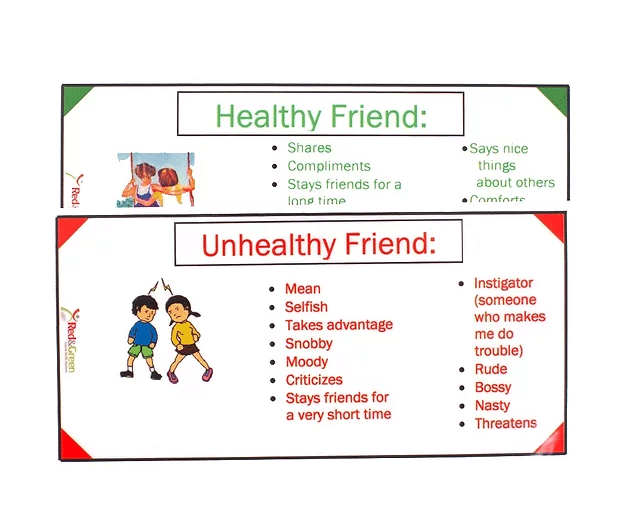
Healthy Friendship How-To Poster

Unhealthy friendships can be hard for kids (and teens) to understand. Red-Green Behavior Therapy’s visual poster set is the perfect social emotional learning materials for teaching healthy relationships and friendship skills to children and young adults.

$20.00

  • Description
  • Specs

Dynamics, dynamics, dynamics

Maybe it's the elementary student who gravitates toward peers who take advantage of their kindness, or the teenager who can't recognize manipulative behavior in their social circle. You want to help them understand the difference between healthy and unhealthy relationships, but how to explain complex social dynamics to a developing mind?

Finding (and being) good friendship material

These aren't feel-good motivational posters with vague friendship quotes. Using proven visual learning principles, our posters present side-by-side comparisons that make abstract concepts like "respect," "loyalty," and "trustworthiness" tangible and understandable. They show the difference between kind and unkind friend behaviors through clear character traits examples that children can immediately recognize and apply. 

For anyone teaching kids about healthy friendships

  • Elementary teachers implementing friendship activities and character education programs
  • School counselors addressing social emotional learning through healthy relationships education
  • Behavior therapists working on social skills development and peer interaction
  • SLPs targeting social communication and pragmatic language skills
  • Mental health professionals teaching relationship boundaries and social awareness
  • Parents wanting concrete tools for friendship conversations at home

Core learning components:

  • Character Recognition Skills - Visual examples of trustworthy vs. untrustworthy behaviors
  • Boundary Understanding - Clear illustrations of respectful vs. disrespectful treatment
  • Social Awareness Development - Pattern recognition for healthy relationship dynamics
  • Self-Advocacy Tools - Confidence to seek friendships that genuinely support their wellbeing
  • Prevention Focus - Proactive skill building before problematic relationships develop
Real Results
  • Improved peer selection through clear criteria for healthy friendships
  • Enhanced social safety by recognizing and avoiding harmful relationships
  • Increased self-worth through understanding respectful treatment standards
  • Better conflict resolution skills within existing friendships
  • Long-term relationship success built on solid foundational understanding
Give children the gift of friendship wisdom using these social emotional learning posters; a  visual roadmap for identifying, understanding, and choosing genuinely supportive friendships.
Kind Friend Posters - Visual examples of supportive, respectful friendship behaviors
Unkind Friend Posters - Clear illustrations of harmful, disrespectful relationship patterns
Detailed Instruction Sheet - Therapeutic applications, discussion prompts, and implementation strategies
Age-Appropriate Adaptations - Flexibility for developmental stages 4½ through 25

Description

Dynamics, dynamics, dynamics

Maybe it’s the elementary student who gravitates toward peers who take advantage of their kindness, or the teenager who can’t recognize manipulative behavior in their social circle. You want to help them understand the difference between healthy and unhealthy relationships, but how to explain complex social dynamics to a developing mind?

Finding (and being) good friendship material

These aren’t feel-good motivational posters with vague friendship quotes. Using proven visual learning principles, our posters present side-by-side comparisons that make abstract concepts like “respect,” “loyalty,” and “trustworthiness” tangible and understandable. They show the difference between kind and unkind friend behaviors through clear character traits examples that children can immediately recognize and apply. 

For anyone teaching kids about healthy friendships

  • Elementary teachers implementing friendship activities and character education programs
  • School counselors addressing social emotional learning through healthy relationships education
  • Behavior therapists working on social skills development and peer interaction
  • SLPs targeting social communication and pragmatic language skills
  • Mental health professionals teaching relationship boundaries and social awareness
  • Parents wanting concrete tools for friendship conversations at home

Core learning components:

  • Character Recognition Skills – Visual examples of trustworthy vs. untrustworthy behaviors
  • Boundary Understanding – Clear illustrations of respectful vs. disrespectful treatment
  • Social Awareness Development – Pattern recognition for healthy relationship dynamics
  • Self-Advocacy Tools – Confidence to seek friendships that genuinely support their wellbeing
  • Prevention Focus – Proactive skill building before problematic relationships develop
Real Results
  • Improved peer selection through clear criteria for healthy friendships
  • Enhanced social safety by recognizing and avoiding harmful relationships
  • Increased self-worth through understanding respectful treatment standards
  • Better conflict resolution skills within existing friendships
  • Long-term relationship success built on solid foundational understanding
Give children the gift of friendship wisdom using these social emotional learning posters; a  visual roadmap for identifying, understanding, and choosing genuinely supportive friendships.
0.0
Based on 0 reviews
5 star
0%
4 star
0%
3 star
0%
2 star
0%
1 star
0%
0 of 0 reviews

Sorry, no reviews match your current selections

You Also May Like...

(0 customer reviews)

by Devora (Samet) Witriol

$20.00
(0 customer reviews)

by Devora (Samet) Witriol

$20.00
(0 customer reviews)

by Devora (Samet) Witriol

$20.00
document.addEventListener("elementor/popup/show", function () { if (window._ctct_m) { window._ctct_m(); } });